Welcome to the MIT Beer Game – Retailer
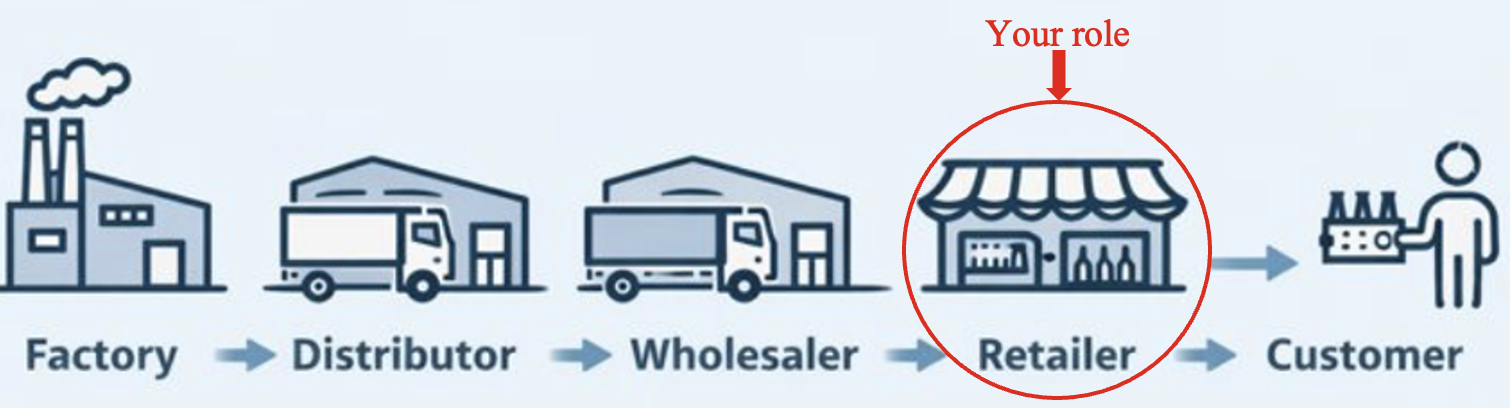
In this game, you act as a retailer within a beer supply chain.
Each week, customers place orders for beer. Based on this demand, you must decide how many units to order from your supplier.
You only have access to local information, such as your current inventory, outstanding backorders, and incoming deliveries.
You do not know future customer demand, and all orders and deliveries are subject to delays.
For example the units you ordered from your supplier (the Wholesaler) will not always arrive immediately the week after,
but could arrive in 2-3 weeks instead or even partially distributed over several weeks.
Your decisions therefore affect the system with a delay, and their full impact may only become visible several weeks later.
Objective
Your objective is to minimize your total costs over the course of the game. These consist of:
-
Inventory costs: occur when beer units remain in stock
- A fixed storage cost of $200 per week applies
- Each unit in inventory incurs an additional $0.50 per unit
- Example:
You have 300 beer units in your current inventory:
300 x $0.50 + $200 = $350 total inventory costs for the week
-
Backlog costs: occur when customer demand cannot be fulfilled immediately
- Each unfulfilled unit incurs a cost of $1 per unit
- Example:
Customers ordered 400 beer units, but you had only 300 in stock. You now have 100 Units in your backlog:
100 x $1 = $100 Backlog Costs
Total Cost = $200 + (Inventory x $0.50) + (Backlog x $1)
Example:
You have 300 beer units in your inventory and a backlog of 100 beer units.
$200 + (300 x $0.50) + (100 x $1) = $450 Total Costs
Balancing these two cost drivers by ordering not too much or too little is the central challenge of the game.
Key characteristics of the game
- Demand is uncertain and cannot be predicted perfectly
- Information is limited to your own position in the supply chain
- Decisions have delayed effects, Orders may be delayed or split up
- Small ordering changes can lead to large fluctuations over time
- Every run will have different Demands and Delays
- You are the only human player, other positions are played by the computer
The game illustrates how coordination problems and delayed feedback can lead to inefficiencies in supply chains.
Dashboard
The dashboard summarizes your start-of-week situation using only the local information available to you as the retailer.
It does not reveal future demand or the internal states of the other supply chain members.
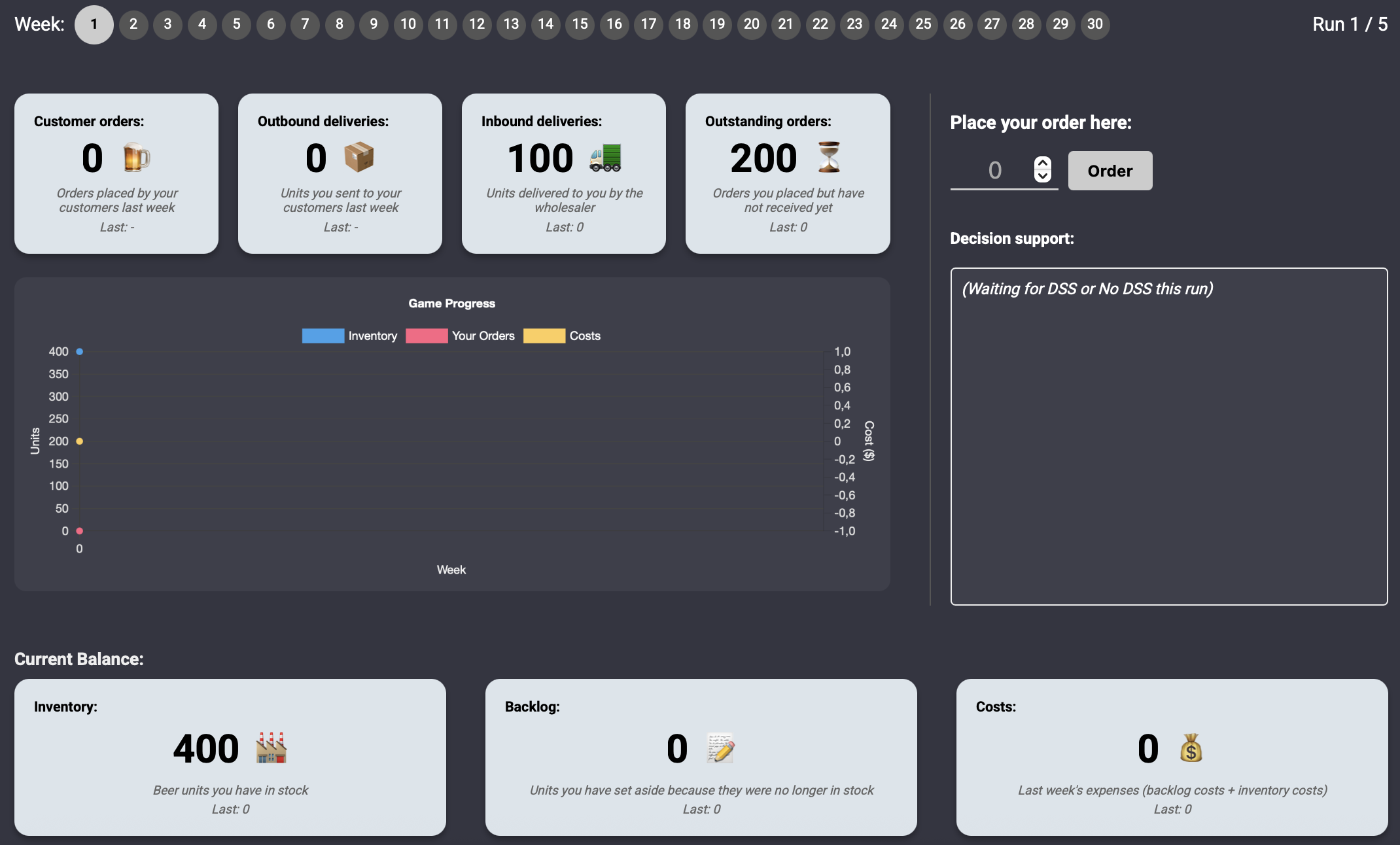
Customer orders
Orders placed by your customers last week. This is the demand you need to respond to as quickly and reliably as possible.
Outbound deliveries
Units you shipped to your customers last week. If inventory was too low, you may not have been able to fulfill all demand immediately.
Inbound deliveries
Units received from the wholesaler last week. These deliveries increase your available inventory for future customer demand.
Outstanding orders
Orders you already placed but have not received yet. They are still moving through the supply chain and may arrive with delay.
Inventory
Beer units currently in stock. This inventory is used to fulfill customer orders, but holding too much stock also creates costs.
Backlog
Customer orders you could not fulfill because inventory was not sufficient. These units remain pending until stock becomes available.
Costs
Last week's expenses from inventory and backlog. These values show how your earlier decisions affected system performance.
Your order decision
The quantity you choose to order from your supplier this week. This decision shapes future inventory, service level, and total cost.